Commercial AV Installation in Boston: How Offices, Restaurants, and Event Spaces Can Prepare for a Better Fall Season
Commercial AV Installation in Boston: How Offices, Restaurants, and Event Spaces Can Prepare for a Better Fall Season
Late summer into early fall is one of the most important times for Boston businesses to take a serious look at their audio visual systems. Offices are preparing for busier in-person schedules, restaurants are getting ready for game-day crowds, event spaces are booking holiday parties, and property managers are trying to clean up technology problems before the colder months push everyone indoors.
For a Boston business, commercial AV is not just about hanging a display on a wall or adding a few speakers. The right system affects how clients experience your space, how employees run meetings, how guests hear announcements, and how smoothly your team operates during busy hours. In a city filled with historic brick buildings, tight tenant spaces, basement-level restaurants, Seaport conference rooms, Back Bay salons, and mixed-use properties, AV needs to be designed around the building itself.
That is where many Boston competitors miss the opportunity. They talk about equipment, but they do not talk enough about the real-world conditions that make commercial AV projects in Boston different: old plaster walls, exposed brick, strict landlord rules, limited ceiling access, shared Wi-Fi networks, noise concerns, and the constant need for clean installations that do not disrupt customers or staff.
Why Boston Businesses Should Upgrade AV Before the Busy Indoor Season
Boston has a very seasonal business rhythm. Summer brings patio dining, tourism, waterfront events, and lighter office schedules. Once September arrives, the city shifts. Colleges are back in session, offices get busier, restaurants see heavier game-day traffic, and companies start planning client events, staff meetings, fundraisers, and holiday parties.
If your conference room camera fails in October or your restaurant audio cuts out during a packed Celtics or Bruins night, the problem becomes urgent. The better strategy is to review the system before the season changes. A commercial AV upgrade in late summer or early fall gives your team time to solve weak spots before the schedule gets crowded.
For offices in the Financial District, Seaport, Back Bay, and Cambridge, this often means improving conference room displays, microphones, cameras, and video conferencing reliability. For restaurants and bars in the North End, South Boston, Fenway, and the South End, it often means better zone-based audio, cleaner TV placement, and easier staff controls. For event spaces and private clubs, it may mean better wireless microphone coverage, brighter displays, and a sound system that works evenly across the room.
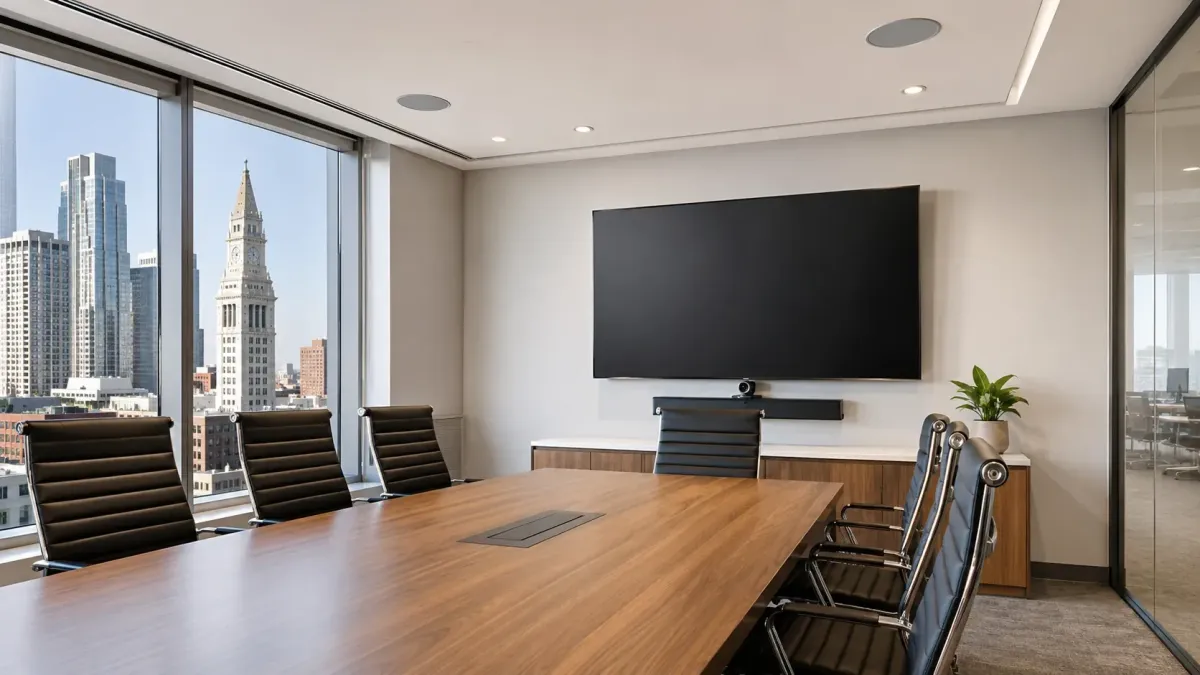
Conference Rooms Need More Than a Big Screen
A lot of Boston offices have conference rooms that look finished but do not perform well. The display is mounted, but the camera angle is awkward. The table microphone picks up every chair scrape. Remote callers cannot hear the person at the far end of the room. Employees waste the first ten minutes of every meeting figuring out how to connect.
That is not a display problem. It is a system design problem.
A good conference room AV setup should account for room size, glass walls, ceiling height, table shape, lighting, camera sightlines, and how your team actually meets. A small legal office in Beacon Hill does not need the same system as a large Seaport boardroom. A real estate office near Newbury Street does not need the same microphone layout as a corporate training room near South Station.
For dependable commercial AV installation in Boston, the goal is to make the room feel simple. Staff should be able to walk in, start a call, share a screen, adjust the volume, and get back to business without calling the one person in the office who “knows the system.”
Restaurants, Bars, and Hospitality Spaces Need Zone Control
Boston restaurants have very different sound needs throughout the day. A quiet lunch in the Back Bay may need soft background music. A busy dinner in the North End needs fuller sound that still allows conversation. A packed game night near Fenway may need TVs, stronger audio, and fast control from behind the bar.
One of the biggest mistakes in restaurant AV is treating the whole space as one zone. In reality, the bar, dining room, private room, entry area, and patio often need separate volume control. Staff should not have to choose between music being too loud in one area and too quiet in another.
Zone-based audio also matters for guest experience. When speakers are placed correctly, customers hear consistent sound without harsh volume spikes. When they are placed poorly, one table sits directly under a loud speaker while another area can barely hear anything. That kind of uneven sound is common in older Boston spaces with narrow rooms, low ceilings, exposed brick, and unusual floor plans.
Businesses with restaurants, clubs, salons, showrooms, or hospitality spaces can often benefit from the same design thinking used in residential whole-home audio systems: multiple zones, clean wiring, easy control, and balanced coverage that fits the way people move through the property.
The Hidden AV Problem: Weak Wi-Fi and Network Planning
Commercial AV is only as reliable as the network behind it. Many businesses think they have an AV issue when they actually have a network issue. Video calls freeze. Wireless presentation devices disconnect. Streaming music cuts out. Smart controls lag. Security cameras drop offline. Staff blame the equipment, but the real problem may be poor Wi-Fi coverage, an overloaded router, or badly placed access points.
This is especially common in Boston buildings with brick walls, concrete floors, steel framing, basement spaces, and multi-tenant layouts. A standard router tucked into a back office is not enough for a modern business that depends on video conferencing, streaming, point-of-sale systems, guest Wi-Fi, digital displays, and smart controls.
For commercial spaces, AV and network planning should happen together. The system should account for where the equipment lives, how many people connect each day, which devices need priority, and whether guest Wi-Fi should be separated from business systems.
Smart Controls Make the System Easier for Staff
A commercial AV system should not require a binder of instructions. The best systems are the ones employees actually use correctly. That usually means simple control from a wall keypad, tablet, remote, or app with clear presets.
For example, a conference room might have presets for “Video Call,” “Presentation,” and “Room Off.” A restaurant might have presets for “Lunch,” “Dinner,” “Game Night,” and “Private Event.” A fitness studio might have presets for classes, cleaning, and front desk audio.
This is where smart home integration concepts translate well into commercial spaces. Lighting, audio, displays, shades, and climate can work together so the room changes with one tap instead of five different remotes and a confused staff member.
Boston Building Conditions Matter
Commercial AV installation in Boston is not like installing in a brand-new suburban office park. A lot of local spaces have quirks: plaster walls, masonry, older electrical layouts, limited conduit access, strict property management rules, elevator scheduling, union building requirements, noise restrictions, and tight installation windows.
A successful AV project needs to respect those conditions. In a Back Bay retail space, the final installation needs to look clean and architectural. In a Seaport office, the technology needs to match a modern buildout. In a South Boston restaurant, the system has to survive heavy daily use. In a Beacon Hill professional office, the wiring plan may need to protect older finishes.
Planning around the building reduces surprises. It also keeps the final result cleaner, safer, and easier to service later.
What Boston Businesses Should Review Before Upgrading
Before scheduling a commercial AV upgrade, business owners should walk through the space and make a short list of what is not working. Are meetings hard to start? Is sound uneven? Are TVs difficult to control? Are wires visible? Does Wi-Fi drop in certain rooms? Do employees avoid using the system because it feels confusing?
Those details help shape the right plan. The goal is not to overbuild the space. The goal is to install the right system for how the business actually operates.
For some companies, that may mean a complete conference room upgrade. For others, it may be a better audio system, cleaner displays, improved Wi-Fi, or simplified controls. A restaurant may need new zones before football season. A financial office may need better hybrid meeting tools before fall client reviews. A venue may need microphone and display upgrades before holiday event season.
The Bottom Line
Boston businesses cannot afford AV systems that only work some of the time. As the city moves from summer into the busier indoor season, offices, restaurants, event spaces, and hospitality businesses should treat AV as part of the customer and employee experience.
The best commercial AV installations are clean, reliable, easy to use, and designed around the realities of Boston buildings. When the display, sound, network, and controls all work together, the technology disappears into the background and the business runs more smoothly.
For Boston companies preparing for a busier fall and winter, now is the right time to fix the weak spots before they become daily problems.