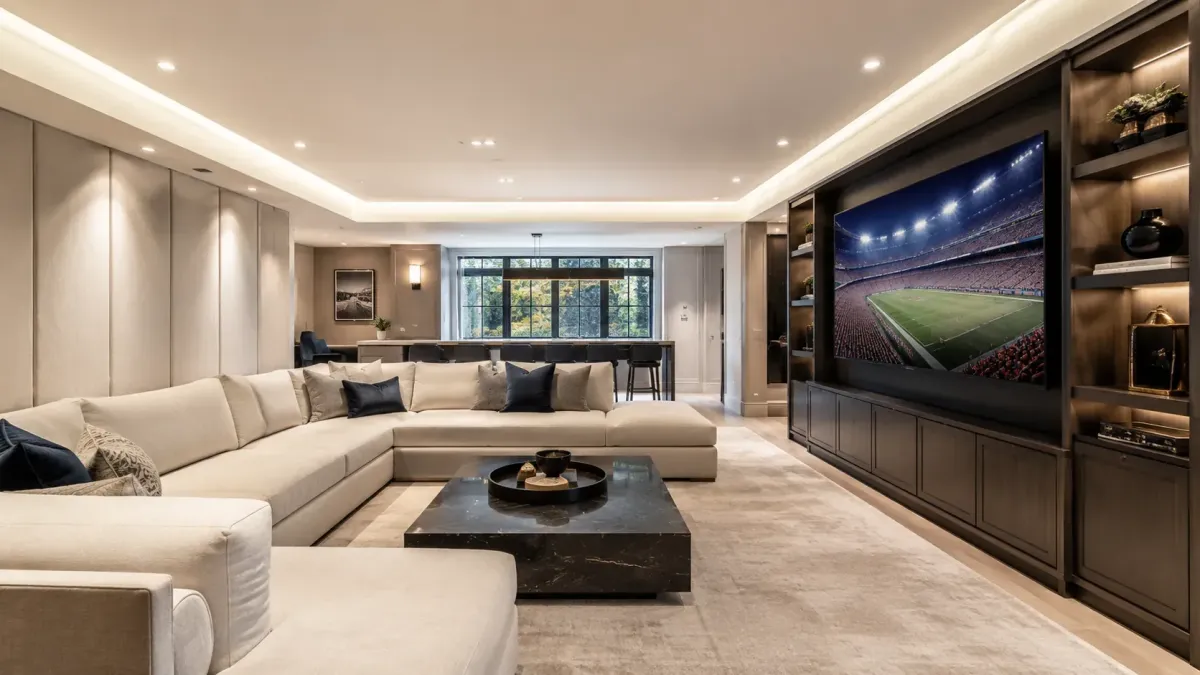
Media Room Design in Boston: How to Turn an Everyday Living Room, Condo Den, or Basement Into a Better Entertainment Space
Media Room Design in Boston: How to Turn an Everyday Living Room, Condo Den, or Basement Into a Better Entertainment Space
Not every Boston homeowner wants a dedicated private cinema. Many want something more flexible: a room that works for movies, sports, streaming, gaming, entertaining, and everyday relaxing. That is where media room design becomes one of the most practical AV upgrades for Boston homes.
A media room is different from a full home theater. It does not need to be completely dark, isolated, or single-purpose. It can be a Back Bay living room, a Seaport condo den, a Brookline family room, a Newton finished basement, a South End parlor, or a South Boston open-concept space. The goal is to make the room perform better without making it feel like a showroom.
This is a major opportunity in Boston because many competitors focus on either basic TV mounting or expensive theater builds. The middle ground is underserved. Plenty of homeowners want better sound, cleaner wiring, smarter lighting, and a more intentional layout, but they still need the room to feel comfortable for daily life.
Why Media Rooms Fit Boston Homes So Well
Boston homes are full of character, but they are not always easy to design around. Brownstones have narrow rooms, fireplaces, built-ins, plaster walls, and limited wiring paths. Condos have association rules, shared walls, concrete ceilings, and strict work-hour windows. Older single-family homes in Jamaica Plain, Roslindale, and West Roxbury may have finished basements with low ceilings or unusual layouts. Newer Seaport and Fenway condos may have beautiful glass walls but limited places to hide equipment.
A media room works because it adapts to the home instead of forcing the home to adapt to the technology. It can be designed around a wall-mounted TV, a projector, in-wall speakers, a soundbar, hidden equipment, dimmable lighting, or a combination of all of those.
The best media room design in Boston starts with how the room is actually used. Is it mostly for movie nights? Celtics and Bruins games? Gaming? Kids’ shows during the day? Entertaining friends? Quiet Sunday streaming? The answer shapes everything from seating to screen size to speaker placement.
Start With Seating, Not the Screen
Many homeowners start with the biggest TV or projector they can fit. That is understandable, but it is not always the best first step. In a media room, seating should guide the design.
Where people sit determines the right screen size, mounting height, speaker placement, lighting plan, and furniture layout. A sectional pushed too far to one side can make the sound feel uneven. A TV mounted too high above a fireplace can make long movie nights uncomfortable. A projector screen may look impressive but fail if the seating distance is too short or the room has too much daylight.
Boston living rooms often have constraints that make layout planning especially important. A fireplace may compete with the TV wall. Windows may create glare. Built-ins may limit speaker placement. Doorways may interrupt the viewing angle. In condos, the best wall for the screen may also be a shared wall where sound control matters.
A thoughtful media room plan solves those issues before equipment is installed.
Sound Is Usually the Biggest Upgrade
Most TVs look good today, but built-in TV speakers still leave a lot to be desired. For Boston homeowners, better audio is often the upgrade that makes the room feel truly different.
A soundbar may be enough for some spaces, especially condos or smaller rooms. But for homeowners who want a more immersive experience, properly placed speakers and a tuned subwoofer can completely change movies, sports, and music.
The challenge is that speaker placement needs to fit the room. In a narrow South End parlor, rear speakers may need to be placed carefully to avoid overpowering the seating area. In a Seaport condo, the system may need to respect shared walls and neighbors. In a finished basement, ceiling height can affect whether in-ceiling speakers make sense. In a Brookline or Newton family room, the system may need to sound great while staying visually discreet.
For rooms where immersive audio is a priority, professional surround sound installation helps with speaker placement, hidden wiring, receiver setup, subwoofer tuning, and room-specific calibration.
Lighting Makes the Room Feel Finished
Lighting is one of the most overlooked parts of media room design. A room can have a great screen and excellent sound but still feel wrong if the lighting is harsh, reflective, or difficult to control.
Boston homes often have mixed lighting conditions. Older rooms may have limited overhead lighting. New condos may have bright recessed lights and large windows. Basements may need layered lighting to avoid feeling flat. Media rooms benefit from dimmable zones, warm accent lighting, shaded windows, and simple presets.
The right lighting plan lets the room shift throughout the day. Bright for cleaning or casual use. Soft for hosting. Low and controlled for movie night. This is especially useful in fall and winter, when Boston evenings get dark early and indoor spaces become the center of home life.
When a Projector Makes Sense
Projectors are not only for dedicated theaters. In some Boston media rooms, a projector and screen can create a big-screen experience without dominating the wall all day. This can work especially well in finished basements, larger family rooms, and multipurpose spaces where a retractable screen keeps the room flexible.
However, projector planning needs to be realistic. Ceiling height, throw distance, light control, seating distance, screen size, and wiring routes all matter. A projector in a bright room with uncontrolled windows may disappoint. A projector in a properly planned room can feel incredible.
For homeowners considering a big-screen layout, projector and screen installation should be planned early in the design process, not after furniture and lighting are already finished.
Hidden Wiring Keeps the Room Looking Like a Home
Clean wiring is one of the biggest differences between a finished media room and a room that simply has equipment in it. Visible cords, exposed power strips, crowded media cabinets, and loose HDMI cables can make even expensive equipment look messy.
Boston homes make wiring concealment more complicated. Plaster, brick, old framing, concrete, and condo restrictions can limit where cables can be run. A good plan may use in-wall wiring where possible, cabinet ventilation, raceway only where necessary, and equipment placement that keeps the room clean without creating service problems later.
The goal is for the technology to feel built in. The room should look intentional when everything is on and still look clean when everything is off.
Design for Game Day and Everyday Life
A Boston media room needs to handle more than movie night. It should work for Patriots Sundays, Red Sox games, Celtics playoff runs, Bruins nights, gaming, family gatherings, and regular weekday streaming.
That means the room should be easy to use. One remote or app should control the main activities. Guests should not need instructions. Kids should not accidentally break the setup by switching inputs. The system should feel simple even if the wiring and equipment behind the scenes are more advanced.
The Bottom Line
Media room design is one of the smartest upgrades for Boston homeowners because it improves the room people already use. Instead of building a separate theater that may only be used occasionally, a media room turns an everyday space into a better version of itself.
The best designs balance comfort, sound, lighting, screen placement, hidden wiring, and simple control. They also respect the realities of Boston homes, from brownstone plaster to condo approvals to basement ceiling heights.
As fall approaches and Boston life moves indoors, now is a strong time to rethink the rooms where your family watches, hosts, relaxes, and spends the most time. A well-designed media room does not just make entertainment better. It makes the whole home feel more finished.